
Adobe Data Breach: Exposes 150 Million Users
The Adobe data breach exposed over 150 million user accounts, highlighting the dangers of weak passwords and password reuse. Learn how this major incident reshaped online security and how tools like Malwarebytes can protect against cyber threats and identity theft.
DATA BREACH
7 min read
Adobe Data Breach: 150 million Users Exposed
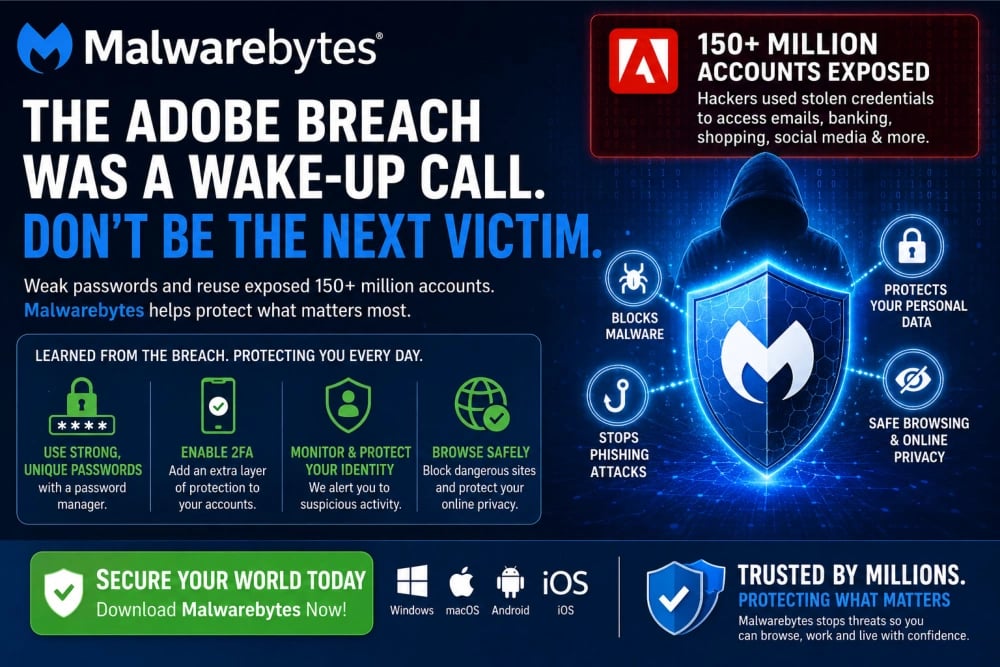
The massive Adobe data breach became a major warning about the dangers of weak passwords and password reuse across websites. Hackers infiltrated Adobe systems and exposed over 150 million user accounts, including email addresses and encrypted passwords. Many users had simple passwords like “123456” or reused the same password for banking, social media, and shopping websites. For example, if someone used the same password for Adobe and Gmail, hackers could potentially access both accounts after the data breach. The incident showed how one weak password could create massive online risks worldwide. Today, cybersecurity tools like Malwarebytes help protect users from Phishing attacks, Malware, and identity theft while improving online account security.

Adobe Data Breach: Exposed Over 150 Million User Data
The massive data breach involving Adobe became one of the most shocking cybersecurity events in internet history because it exposed how weak password protection and password reuse could put millions of people in danger. In 2013, hackers successfully infiltrated and caused a data breach in the Adobe systems and exposed more than 150 million user accounts, making it one of the largest data breaches ever discovered at the time. Many users had simple passwords like “123456,” “password,” or their pet’s name, and countless people reused the same password across social media, banking, email, and shopping websites. For example, a user who used the same password for Adobe and Facebook could unknowingly allow hackers to access both accounts after the breach. The incident became a turning point that forced companies and individuals to rethink online security. Today, cybersecurity tools like Malwarebytes help users detect cyber threats, block malicious attacks, and protect from personal data breaches before hackers can exploit weak digital habits.
How Hackers Successfully Infiltrated Adobe Systems
Cybersecurity experts later discovered that hackers infiltrated Adobe systems and caused a data breach using sophisticated attack techniques that targeted internal company infrastructure. Attackers often begin by stealing employee credentials, exploiting software vulnerabilities, or using phishing emails to gain unauthorized access. In Adobe’s data breach case, investigators found evidence that attackers accessed source code and internal databases containing customer information. Imagine an employee receiving an email that appears to come from the IT department requesting a password reset. If the employee clicks a malicious link, hackers can secretly capture login credentials and enter company systems unnoticed. Once inside, cybercriminals often move laterally through servers until they locate valuable sensitive information and attempt a data breach. The Adobe data breach showed how even major technology companies can become vulnerable if every security layer is not fully protected. Modern cybersecurity software like Malwarebytes Premium Security helps individuals and businesses detect phishing attempts, suspicious behavior, and malware infections before hackers gain access to critical systems and confidential information.
What Data Was Stolen During the Massive Attack
The Adobe data breach exposed a huge amount of sensitive customer information, including usernames, email addresses, encrypted passwords, and even partial payment card information. Although Adobe stated that many passwords were encrypted, cybersecurity researchers later discovered that poor encryption practices made it easier for attackers to analyze password patterns. For example, if thousands of users used passwords like “welcome123” or “adobe2020,” hackers could identify repeated encrypted values and eventually crack them. This meant cybercriminals could attempt those same passwords on other websites such as Gmail, PayPal, or Netflix. Many people unknowingly reused identical passwords across multiple services, turning one breach into a chain reaction affecting countless online accounts. The attack highlighted why storing sensitive data securely is essential for every organization. Today, users can strengthen their protection with security tools like Malwarebytes, which blocks malicious websites, phishing pages, fake downloads, and dangerous online trackers that criminals use to steal personal information.
Why More Than 150 Million Accounts Were Exposed
One reason the Adobe data breach became so catastrophic was the enormous number of customer accounts stored within centralized databases. Large companies often maintain massive collections of customer data to manage subscriptions, purchases, and account access. When hackers breach such systems, they can potentially steal millions of records in a single attack. In Adobe’s case, more than 150 million accounts were exposed because attackers gained access to customer databases containing years of accumulated user information. Imagine a giant warehouse containing millions of confidential files protected by weak locks. Once criminals open the main door, they can potentially access everything inside. Many companies at the time underestimated how valuable customer data was to cybercriminals operating on underground marketplaces. Stolen accounts could be sold, traded, or used for identity theft and credential stuffing attacks. Security solutions like Malwarebytes Identity Theft Protection now help users monitor suspicious activity, protect personal information, and reduce the risks associated with large-scale data breach.
Weak Password Protection Created Dangerous Global Risks
The Adobe data breach demonstrated how weak password protection could create internet-wide security problems affecting millions of users beyond the original attack. Many people choose short, predictable passwords because they are easier to remember, but hackers use automated tools capable of testing billions of password combinations within minutes. For example, passwords like “qwerty,” “football,” or “india123” can often be cracked almost instantly using dictionary attacks. Even worse, many users slightly modify passwords instead of creating truly unique combinations. Someone might use “John123” for Adobe and “John1234” for banking, making it easier for hackers to guess related passwords. Weak password practices allowed cybercriminals to launch credential stuffing attacks against multiple websites after the Adobe data breach. These attacks use stolen usernames and passwords to automatically test logins across different platforms. Today, cybersecurity experts strongly recommend using complex passwords combined with security software like Malwarebytes for Windows to defend against malware, spyware, ransomware, and account compromise attempts.
The Dangerous Habit of Password Reuse Across Websites
Password reuse became one of the biggest cybersecurity concerns exposed by the Adobe incident because millions of people used the same credentials across multiple platforms. A person might use one password for email, social media, online shopping, streaming services, and even banking accounts simply to avoid memorizing multiple passwords. Unfortunately, this creates a domino effect whenever one website suffers a breach. For example, if hackers steal someone’s Adobe credentials and discover the same password works for Facebook or Gmail, they can quickly hijack those accounts too. Cybercriminals use automated software to test stolen credentials across thousands of popular websites within seconds. This practice, known as credential stuffing, has become one of the most common hacking techniques worldwide. The Adobe data breach taught internet users that every online account should have a unique password. Modern security tools like Malwarebytes Mobile Security help users protect smartphones and tablets from malicious apps, phishing scams, and dangerous links that attempt to steal login credentials.
How the Breach Changed Global Cybersecurity Awareness
Before the Adobe data breach, many internet users underestimated the seriousness of cybersecurity threats and online account protection. People often assumed that major companies automatically kept their information safe without requiring additional personal security measures. However, the exposure of more than 150 million accounts changed public perception dramatically. News headlines worldwide discussed password safety, phishing attacks, data breach, and digital privacy concerns. For example, families began realizing that a hacked email account could expose financial information, personal photographs, and sensitive conversations. Businesses also recognized that poor cybersecurity practices could damage customer trust and lead to enormous financial losses. Governments, security researchers, and technology companies started promoting stronger password policies and better encryption standards. The Adobe data breach incident became a powerful lesson showing that cybersecurity is everyone’s responsibility, not just the job of IT departments. Today, solutions like Malwarebytes ThreatDown help businesses strengthen cybersecurity defenses, monitor threats, and respond rapidly to suspicious activity before attackers cause widespread damage.
Why Password Managers Became Essential After the Data Breach
After the Adobe data breach exposed the dangers of password reuse, cybersecurity experts increasingly encouraged users to adopt password managers. A password manager securely stores unique passwords for every account so users no longer need to memorize dozens of complex combinations. For example, instead of using “Summer2024” everywhere, a password manager can generate strong passwords like “7&Lp#91zQ!” for each website individually. Even if one account becomes compromised, the other accounts remain protected because every password is different. Many people initially worried that password managers would be difficult to use, but modern applications simplify the process by automatically filling login forms and securely encrypting stored credentials. The Adobe data breach showed that human memory alone is not reliable enough for modern cybersecurity demands. Combined with trusted protection software like Malwarebytes Personal Cybersecurity Solutions, password managers help users reduce exposure to phishing attacks, malware infections, and credential theft while making internet browsing safer and more convenient for everyday users.
Growing Importance of Two-Factor Authentication to Prevent Data Breach
The Adobe data breach also accelerated the adoption of two-factor authentication, commonly known as 2FA. Two-factor authentication adds an extra security layer beyond passwords by requiring users to verify their identity using another method, such as a mobile app code, fingerprint scan, or text message. For example, even if hackers steal someone’s password through a phishing attack, they still cannot access the account without the secondary verification code. Before major breaches like Adobe’s, many users considered two-factor authentication unnecessary or inconvenient. However, cybersecurity incidents proved that passwords alone were no longer sufficient protection against modern cybercrime. Today, banks, email providers, social media platforms, and online businesses strongly encourage 2FA because it dramatically reduces unauthorized access attempts. Imagine a thief stealing your house key but still needing a fingerprint to unlock the front door. Security software like Privacy VPN further enhances online safety by encrypting internet traffic and protecting users from hackers monitoring public Wi-Fi connections or intercepting sensitive information online.
How Cybercriminals Exploit Stolen Credentials Today
The long-term impact of the Adobe data breach continues today because cybercriminals still rely heavily on stolen credentials to infiltrate accounts and networks. Once hackers obtain login details, they may sell them on dark web marketplaces where other criminals purchase access to email accounts, streaming subscriptions, or even business systems. For example, stolen credentials from one website can eventually contribute to ransomware attacks targeting hospitals, schools, or companies. Attackers frequently combine password theft with phishing scams, malware infections, and fake login pages to maximize success. Many users still underestimate how valuable their online accounts are to criminals. Even a simple email account can provide access to password reset links for dozens of other services. This is why cybersecurity experts now recommend layered protection strategies involving strong passwords, password managers, 2FA, antivirus software, and safe browsing habits. Advanced tools like Endpoint Protection help organizations detect suspicious activity, stop malware attacks, and prevent unauthorized access before criminals spread throughout networks.
Lessons the World Learned From the Adobe Data Breach
The Adobe data breach became one of the defining cybersecurity lessons of the modern internet era because it revealed how interconnected online security truly is. One company’s security failure created risks for millions of users across countless unrelated websites due to password reuse and weak account protection habits. The breach taught individuals that cybersecurity is not optional in a digital world where hackers constantly search for vulnerable targets. For example, a single compromised password can expose social media accounts, online banking, cloud storage, and business communications simultaneously. It also showed companies the importance of encrypting data properly, monitoring suspicious activity, and responding quickly to emerging threats. Most importantly, the incident encouraged internet users to take personal cybersecurity more seriously through stronger passwords, two-factor authentication, password managers, and reliable security software. Modern protection platforms like Malwarebytes Cybersecurity Solutions continue helping millions of users worldwide defend against phishing, ransomware, spyware, malicious websites, and identity theft in an increasingly dangerous digital landscape.
Cyber Security Threats
Malwarebytes Premium
Protect all your devices from all Malware and Viruses
© 2025. All rights reserved.